

The 5 Best Shopify Bundle Apps in 2026 (Compared)
Product bundles are one of the most reliable ways to raise your average order value, and Shopify's app store has dozens of apps that promise to build them for you. Most comparison posts list fifteen of them and help you with none. This one compares five popular apps, each representing a distinct bundle workflow: build-your-own bundle pages, budget volume discounts, product page deal widgets, an all-in-one upsell toolbox, and Shopify's own free fixed-set app.
Full disclosure up front: Bundly is our app. We put it first in this list, and in exchange we'll be straight with you about where each competitor is genuinely better, because every app here is the right choice for somebody.
The Quick Verdict
If you only have ten seconds:
Best for build-your-own and mix-and-match bundles: Bundly
Best free plan: Bundler
Best product page upsell widgets: Kaching Bundles
Best all-in-one upsell toolbox: Fast Bundle
Best if you only need simple fixed sets: Shopify Bundles (free, native)
The rest of this post explains each pick, with the trade-offs included.
How We Compared These Apps
We build a bundle app, so we know this category from the inside: we watch what merchants who switch to Bundly complain about, and we hear why some pick a competitor instead. For this comparison we also installed each app on a test store and did the same run with all of them:
Built the bundle types each app advertises, and noted which ones it can't build.
Placed test orders and checked what the order and inventory look like afterwards.
Compared pricing models: flat fee versus tiers capped by sales or generated revenue.
Checked what each free tier really includes, and where the paid wall starts.
Pulled ratings, review counts, and prices from each Shopify App Store listing in September 2026.
We didn't score setup time with a stopwatch or run conversion experiments; where an entry says an app is "polished" or "dated," that's our judgement from using it.
Tested on August 20, 2026. Ratings and pricing re-checked on September 13, 2026.
Comparison Table: Shopify Bundle Apps at a Glance
App | Best for | Free plan | Paid plans | Rating (Sep 2026) | Key limitation |
|---|---|---|---|---|---|
Bundly | Mix-and-match, multi-step builders, curated sets | No (14-day trial) | $29–$59/mo, flat, unlimited sales | 4.9 (61 reviews) | No free plan |
Bundler | Volume discounts on a budget | Yes, unlimited orders | $9.99–$19.99/mo, flat | 4.9 (2,670 reviews) | App-managed bundle inventory; mix-and-match is paid |
Kaching Bundles | Product page upsell widgets | No (7-day trial) | $14.99–$59.99/mo, capped by generated revenue | 5.0 (5,889 reviews) | Price grows with revenue; no step-by-step builder |
Fast Bundle | All-in-one upsell toolbox | No (7-day trial) | $19–$139/mo, capped by bundle sales | 5.0 (3,413 reviews) | Price grows with sales; limited mix-and-match builder |
Shopify Bundles | Simple fixed sets | Yes, entirely free | None | 2.8 (575 reviews) | Fixed bundles only, hard variant limits |
Note the pricing models, because they matter more than the sticker price. Bundly and Bundler charge a flat monthly fee no matter how much you sell. Kaching and Fast Bundle use usage-capped tiers, so your bill goes up as your bundles succeed. Example: $4,000 of monthly bundle sales puts you on Fast Bundle's $139 plan, and $4,000 of additional revenue puts you on Kaching's $29.99 plan; at $800 the bills are $19 and $14.99. Neither model is wrong, but you should know which one you're signing up for.
1. Bundly: Best for Mix-and-Match and Build-Your-Own Bundles
Verdict in one sentence: if you want customers to build their own bundle on a proper bundle page, with a mix-and-match grid or a step-by-step flow, Bundly is the strongest option on this list.
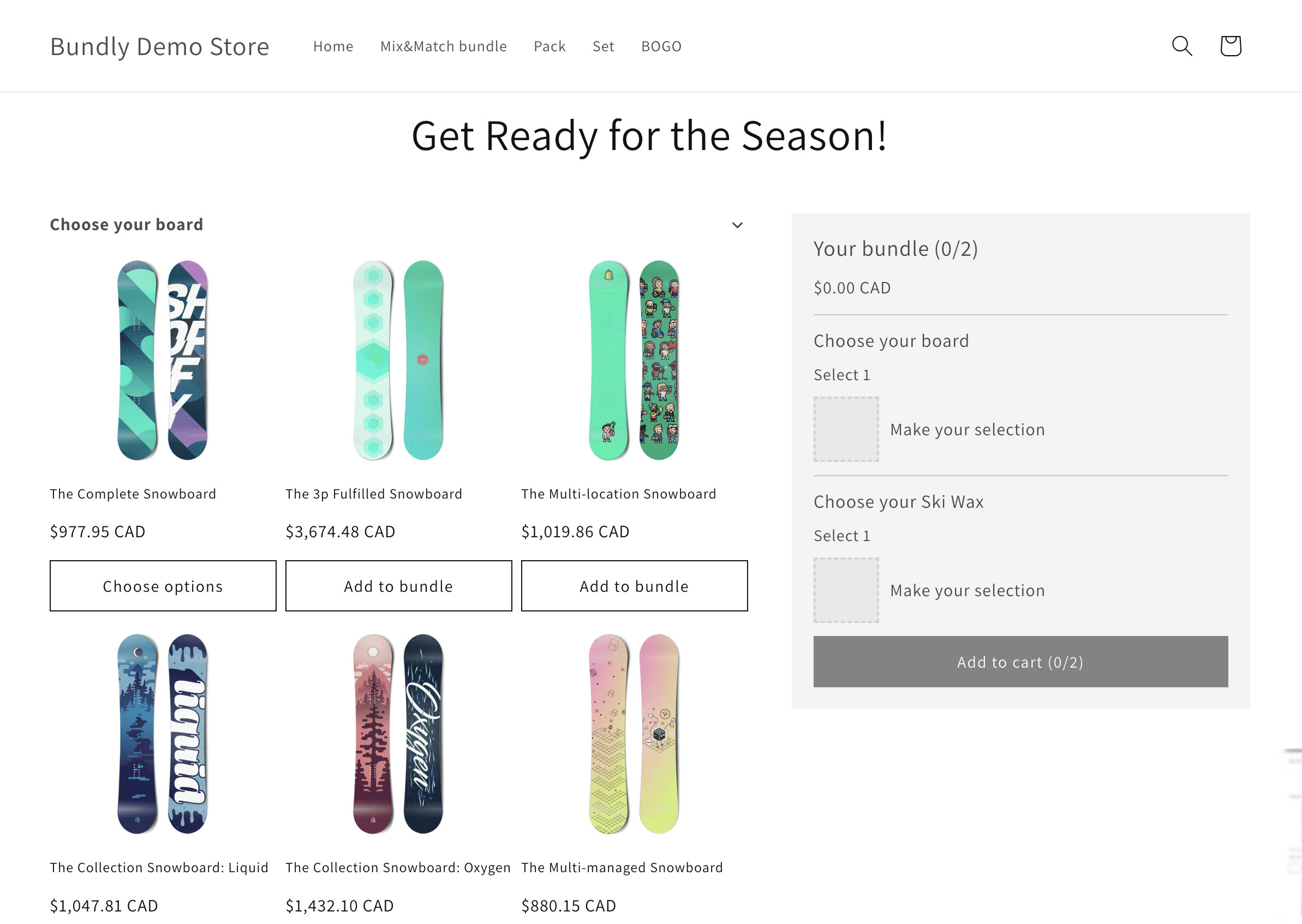
Bundly is built around the idea that a bundle deserves its own page, not just a discount block. You create a bundle, and Bundly generates a real Shopify product with a dedicated, brandable bundle page. Customers pick their items ("choose any 5 teas for $30"), follow a multi-step flow ("pick a shirt, then trousers, then an accessory"), or add a curated set in one click.
Why choose it:
All three bundle types in one app: mix-and-match, multi-step builders, and curated sets, with percentage off, fixed amount off, or set-price pricing.
Light on the storefront. Shopify renders the bundle page itself from data stored on the product, the storefront makes zero requests to Bundly's servers, and every selection and price update happens in the browser with no round-trip per click. The whole widget is one script of about 56 KB compressed, loaded only on pages that show a bundle.
Bundles are regular Shopify products. They get their own URL, SEO settings, collections, and search visibility, so bundle pages can rank in Google on their own.
Full support for Shopify Markets, B2B catalogues, and every currency you sell in, with the storefront widget translated into 32 languages. If you sell internationally, this one matters: many bundle apps quietly break outside your home market.
Product page upsell shows the full bundle on individual product pages, which is where most bundle sales start.
Analytics on two levels: sales reports (revenue, orders, returns, units sold, and bundles' share of your store's total revenue and orders) and storefront reports (bundle views, selections, add-to-cart rate, and a conversion funnel), so you see which bundles convert, not just which ones sell.
Where it falls short:
There's no free plan, only a 14-day trial. Plans are $29/month (Basic) or $59/month (Standard, which adds variant filtering and extended analytics). If you just want a simple "buy 2, save 10%" block, Bundler or Kaching will do it for less.
It's a newer app: 4.9 stars, but a review count in the dozens, not the thousands like the giants on this list.
Pricing: $29 or $59 per month, flat. Unlimited orders and bundle sales on every plan, so your bill doesn't grow when your bundles take off. The Basic plan keeps 7 days of storefront analytics data; Standard keeps up to a year. Across hundreds of stores in more than 30 industries, the average order value rose 12.3% after installing Bundly, comparing each store's AOV before and after install. Over $20 million worth of bundles have been sold through the app.
Best fit: stores with variety (food, beauty, apparel, gifts) that want a real build-your-own experience, and stores selling through Shopify Markets or B2B.
2. Bundler: Best Free Plan
Verdict in one sentence: Bundler's free plan is the most generous in the category, and for basic volume discounts it may be all you ever need.
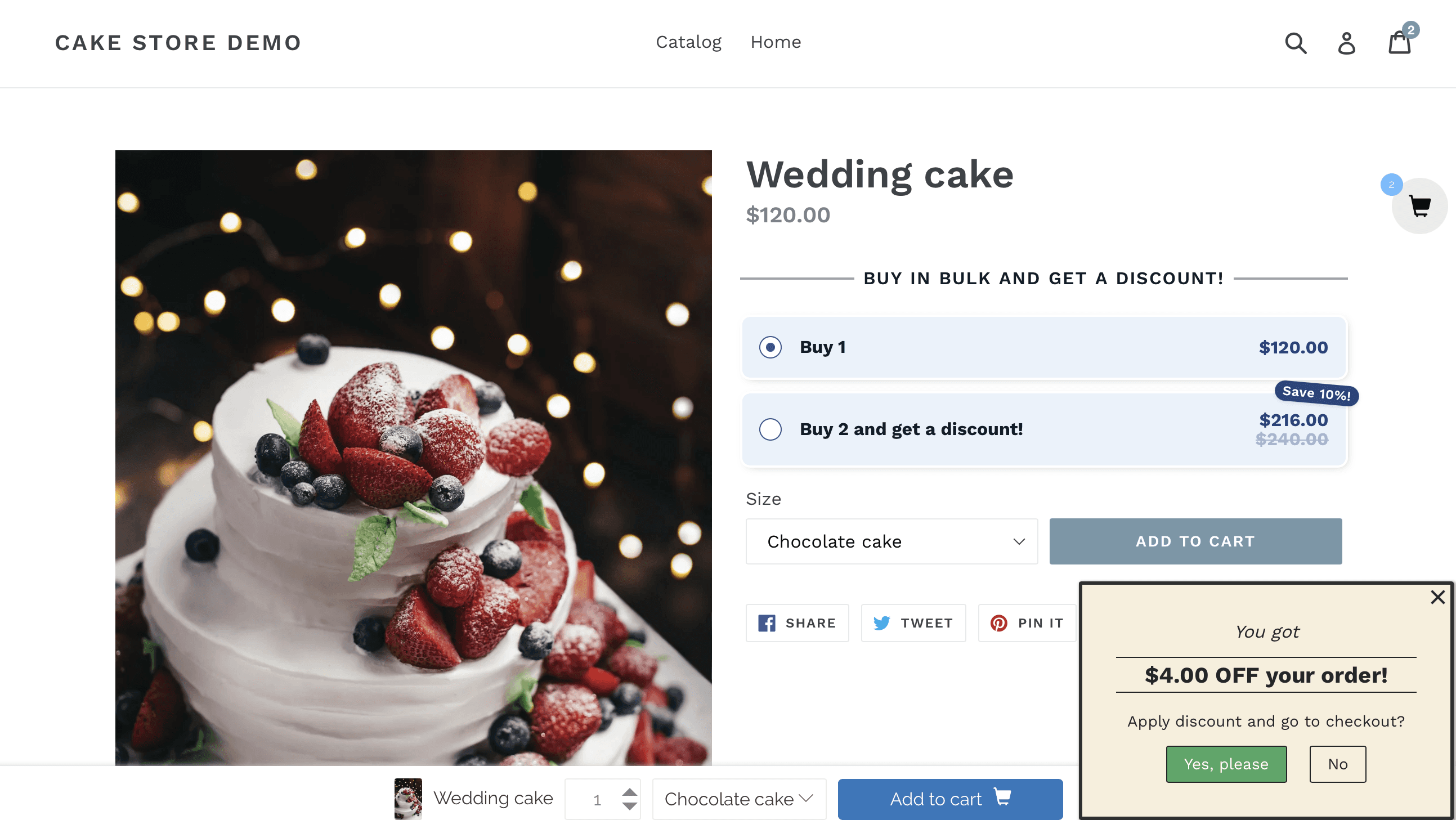
Bundler has been around for years, and it shows in the numbers: 4.9 stars across more than 2,500 reviews. Its free plan includes volume discounts, quantity breaks, Buy X Get Y offers, product page upsells, and POS support, with no order limits. That's a genuinely usable free tier for those bundle types, not a trial in disguise.
Why choose it:
The free plan has unlimited revenue and orders. No other app on this list offers that.
Paid plans are cheap and flat: Premium at $9.99/month adds mix-and-match bundles and landing pages, Executive at $19.99/month adds analytics.
Wide coverage: POS, multi-currency, 16+ languages, subscription product integration.
Where it falls short:
Bundler doesn't use Shopify's Cart Transform API. A multi-product bundle doesn't expand into its component items in the cart and order: it stays a separate product with its own separate inventory, and the app has to keep that stock number in sync with the components itself. In our test order, the order showed a single line item, the bundle product with its own SKU; the component products did not appear as lines. Any sync like that can lag or drift, which complicates fulfilment and risks discrepancies. Apps built on Cart Transform (like Bundly and Shopify's native app) sell the component products directly, so there's no bundle inventory to sync in the first place.
The free plan covers only the simplest bundle types. Mix-and-match requires a paid subscription, and so do analytics, so compare paid tiers, not the free tier, if that's your use case.
The admin interface is cluttered, and configuring bundles takes more trial and error than it should. Even on paid plans, there's no multi-step builder flow, and the storefront widgets look dated next to newer apps.
Pricing: free plan for volume discounts and quantity breaks, then $9.99 or $19.99 per month, flat.
Best fit: budget-conscious stores that mainly want quantity breaks and volume discounts, and want to start without paying anything.
3. Kaching Bundles: Best for Upsell Widgets on the Product Page
Verdict in one sentence: Kaching makes the best product page upsell widgets in the app store, and a 5.0 rating across 5,800+ reviews says merchants agree.
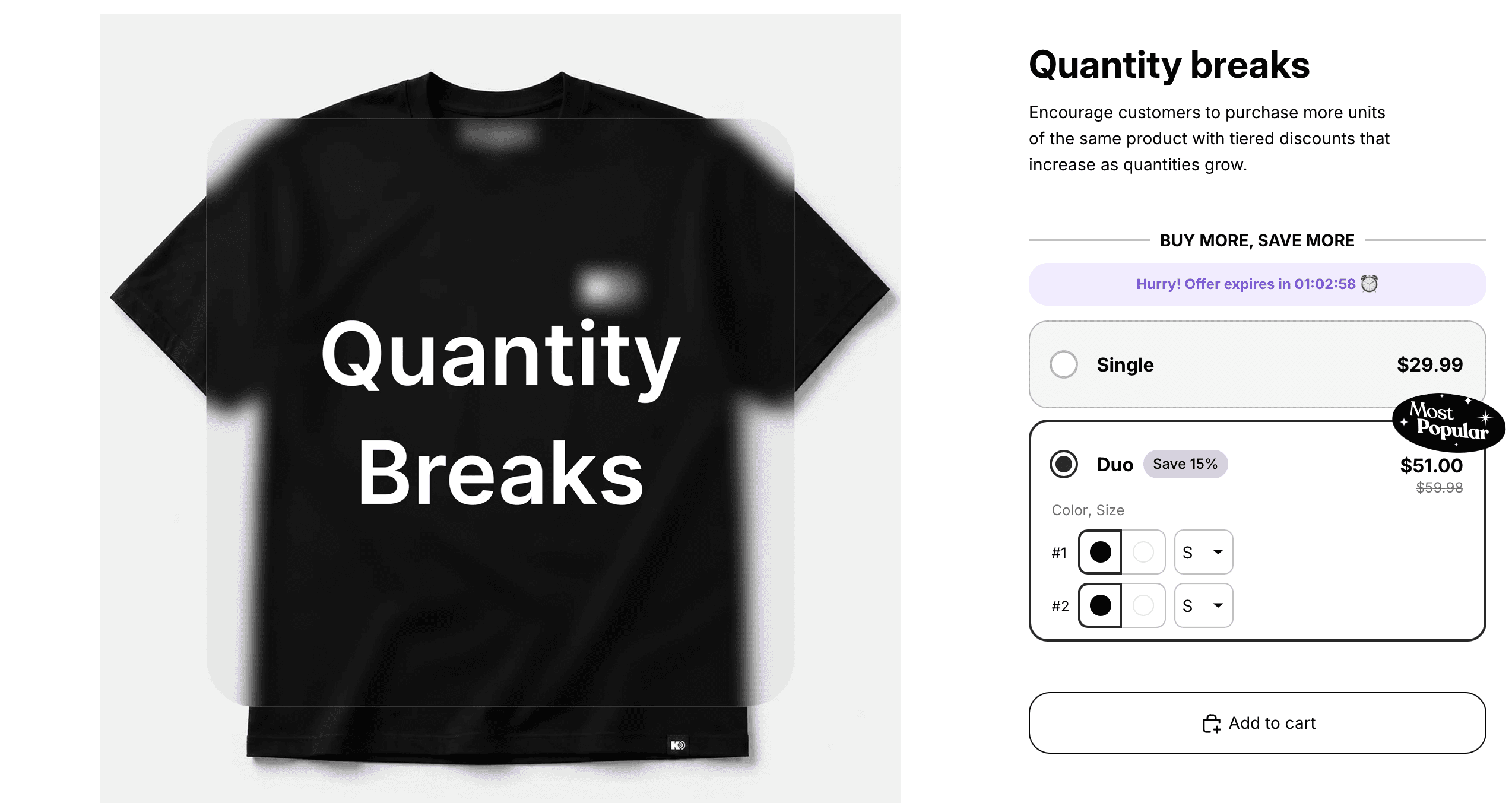
Kaching's focus is the product page. You drop a polished, drag-and-drop deal widget under your add-to-cart button: quantity breaks, tiered discounts, BOGO, free gifts. The widgets are more customizable than anything comparable we tested: layouts, colours, badges, and per-tier styling are all adjustable without code. It also includes built-in A/B testing so you can check which offer actually converts, which is rare in this category.
Why choose it:
The upsell widgets are well designed and deeply customizable, down to per-tier layouts and styling, all without code.
Built-in A/B testing and a clear revenue dashboard.
A 5.0 rating across 5,800+ reviews is the strongest social proof on this list.
Where it falls short:
It's a widget app, not a bundle-page app. There's no build-your-own or mix-and-match bundle type that lives on its own product page, and no step-by-step flow. If you want customers to assemble a box across products or categories, this isn't the tool for it.
Pricing tiers are capped by the additional revenue the app generates: $14.99/month covers up to $1,000, $29.99 up to $5,000, $59.99 up to $10,000. The better it works, the more you pay: $4,000 of additional revenue puts you on the $29.99 plan, $8,000 on the $59.99 plan. The listing shows no plan above $10,000, so ask before you commit if you expect more.
Pricing: from $14.99 to $59.99 per month, tiered by generated revenue, 7-day free trial.
Best fit: stores selling multiples of the same product (consumables, supplements, socks) that want a high-converting offer block on the product page with minimal setup.
4. Fast Bundle: Best All-in-One Upsell Toolbox
Verdict in one sentence: Fast Bundle is a strong pick for upsells on product pages, with the widest feature spread on this list, as long as your bundle volume fits its pricing tiers.
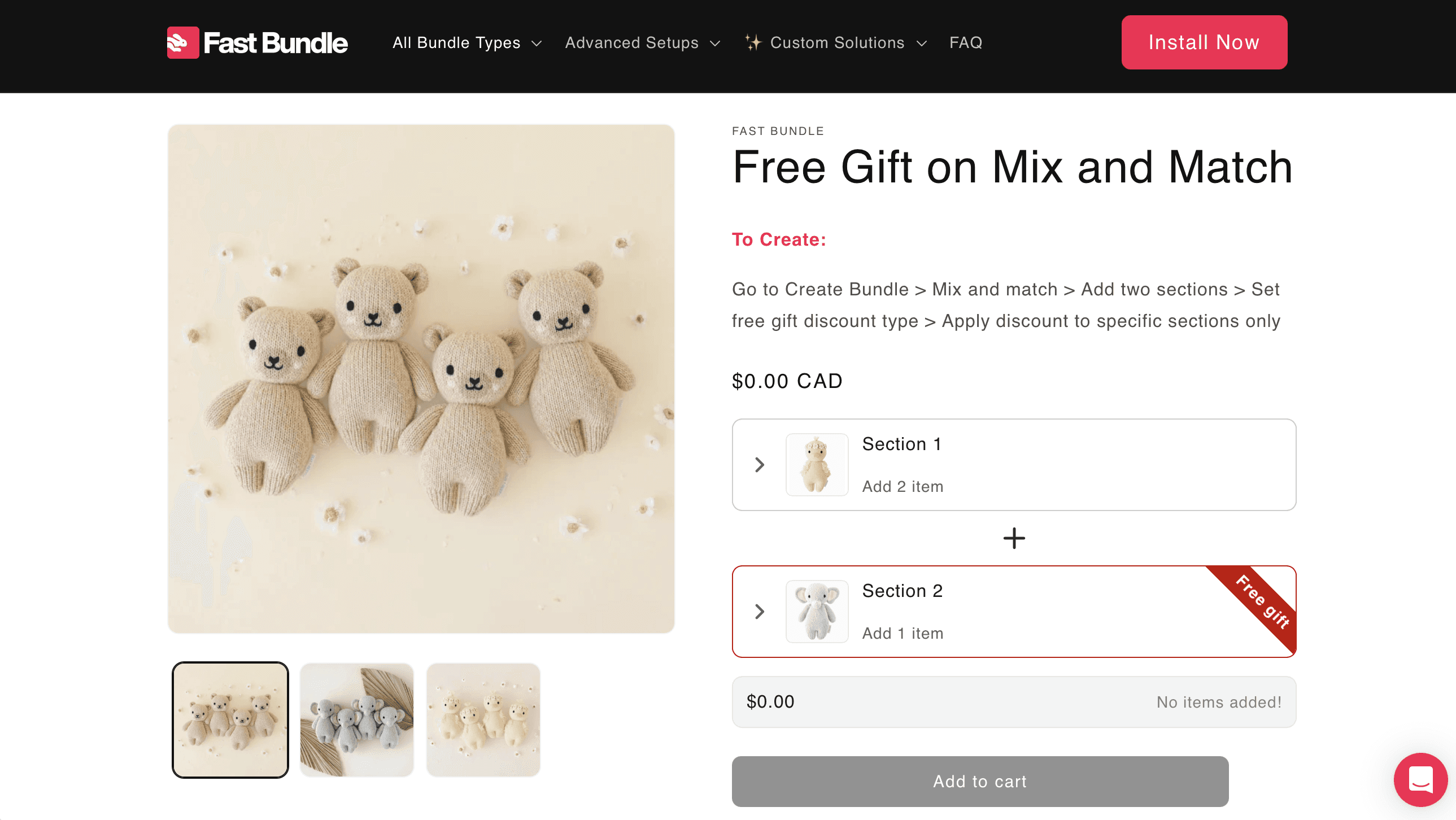
Fast Bundle (listed as "FBP | Fast Bundle & Upsell App") covers fixed bundles, mix-and-match, volume discounts, Buy X Get Y, product add-ons, and AI-powered "frequently bought together" recommendations. It's the Swiss army knife of the category, with a 5.0 rating across 3,400+ reviews and 24/7 support.
Why choose it:
Strong product page upsells: bundle offers, add-ons, and cross-sells right where the customer is already buying.
One app covers nearly every offer type, so you don't need to stack a bundle app plus an upsell app plus a cross-sell app.
AI features (bundle suggestions, frequently-bought-together) do some of the merchandising thinking for you.
Where it falls short:
The mix-and-match builder is simpler than a dedicated builder app. Fast Bundle can give a mix-and-match bundle its own page and its own bundle product, but there is no multi-step flow. For a plain "pick your items" offer it works; for a guided build-your-own it does not.
Pricing is capped by monthly bundle sales: $19/month covers up to $1,000 in bundle sales, $49 up to $3,000, $139 up to $10,000. A store selling $4,000 of bundles a month is already on the $139 plan, because the $49 plan stops at $3,000. The listing shows no plan above $10,000 of monthly bundle sales.
Pricing: from $19 to $139 per month, tiered by bundle sales volume, 7-day free trial.
Best fit: stores that want to experiment with many offer types under one roof and whose bundle volume fits the lower tiers.
5. Shopify Bundles: Best If You Only Need Simple Fixed Sets
Verdict in one sentence: Shopify's own free app handles basic fixed sets with synced inventory, and nothing more.
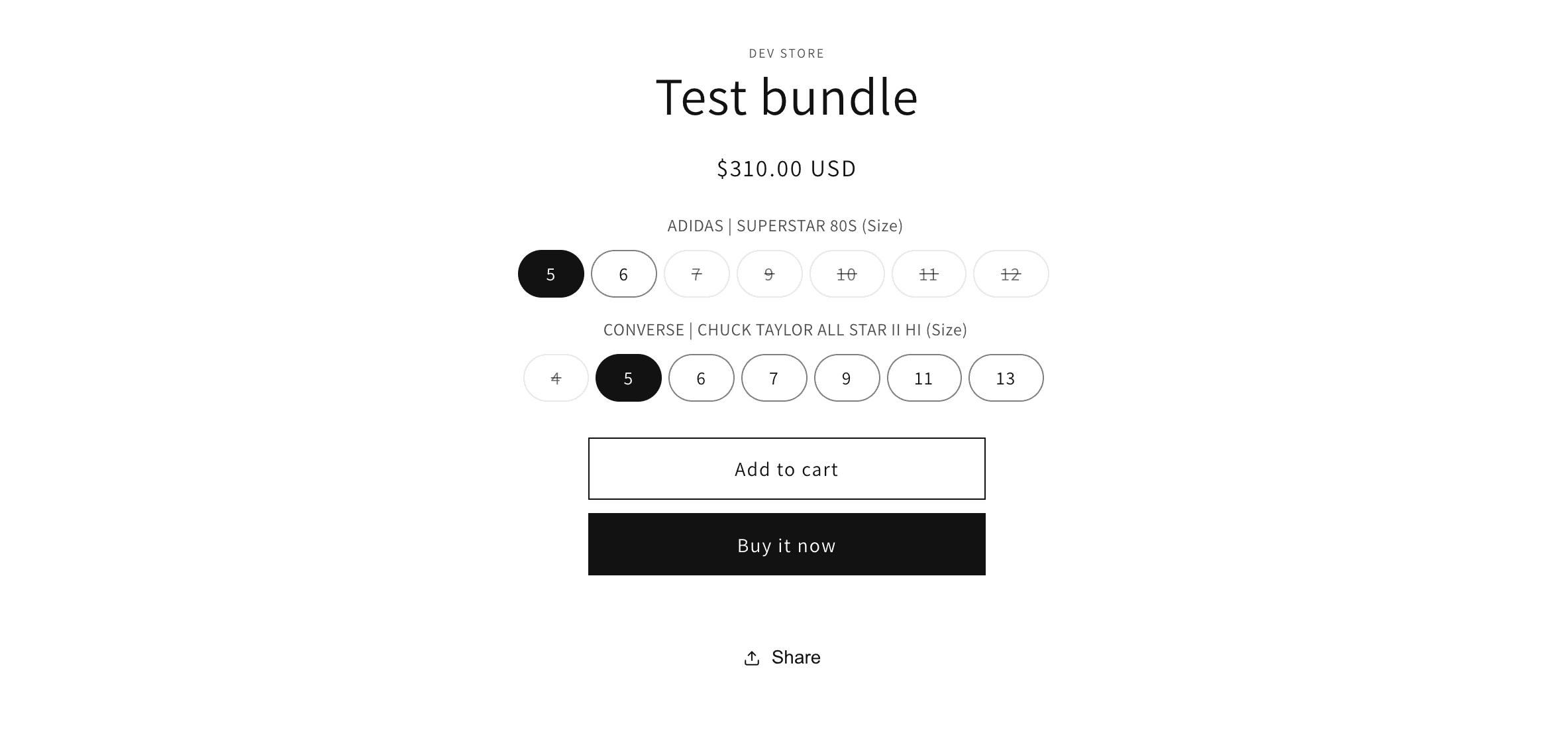
The Shopify Bundles app is free, built by Shopify, and does one job: fixed bundles and multipacks with real-time inventory sync. Its capabilities and limits are documented in Shopify's Bundles guide. Customers can still choose options like size or colour for the products inside the bundle, and when a bundle sells, each component's stock updates, so you won't oversell. For a shampoo-and-conditioner set, it's honestly all you need.
Why choose it:
Free, forever, with no app to pay for and no third-party code in your theme.
Real-time inventory sync done right, by the platform itself.
Where it falls short:
Fixed bundles only. Customers can pick variants of the products you chose, but not the products themselves: no mix-and-match, no build-your-own, no multi-step flows, no product page upsells, no cart detection.
Hard documented limits: 3 options per bundle and 100 variants, which breaks down fast for products with many sizes and colours.
The 2.8 rating across 500+ reviews mostly reflects merchants hitting those walls, not bugs.
Pricing: free.
Best fit: stores that need one or two simple pre-made sets and nothing else. If that's you, start here; you can always move to a dedicated app when you outgrow it. We wrote a full breakdown of what the native app can and can't do in our bundle creation guide.
How to Choose the Right Bundle App for Your Store
Five good apps, one store. Here's the short decision path:
Start with the bundle type you actually want to sell. Fixed sets only? Shopify Bundles or any app here handles it. A basic mix-and-match offer? Bundler (on paid plans), Fast Bundle, and Kaching each have a version. A bundle where customers build their box step by step, on a page that ranks like any other product? That's Bundly.
Check the pricing model against your volume. If your bundles might do serious numbers, a flat fee (Bundly, Bundler) is predictable, while usage-capped tiers (Kaching, Fast Bundle) grow with your success and move between tiers as your sales move.
Check your markets. Selling in multiple currencies, through Shopify Markets, or B2B? Verify support explicitly. Bundly supports all three; several apps in the category don't.
Then use the trial. Every paid app here has one. Set up one real bundle, place a test order, and check what your order admin and inventory look like afterwards. That last step is where the differences show.
Once you've picked an app, the bigger wins come from what you bundle and how you price it. Our guides on creating bundles step by step and raising average order value cover both.
FAQ
What is the best product bundle app for Shopify?
It depends on the bundle type you want to sell. For mix-and-match and build-your-own bundles with dedicated bundle pages, Bundly is the strongest pick. For simple volume discounts on a budget, Bundler's free plan is hard to beat. For highly customizable upsell widgets on the product page, Kaching leads. There is no single best app for every store, which is why this comparison sorts them by use case.
Does Shopify have a built-in bundle feature?
Yes. Shopify's free Bundles app creates fixed bundles and multipacks with real-time inventory sync. It doesn't support mix-and-match bundles, multi-step builders, or product page upsells, and it caps bundles at 3 options and roughly 100 variant combinations. Most stores that want customer choice outgrow it quickly.
Can I create bundles on Shopify without any app?
Yes, in three ways: create the bundle as a new standalone product, add bundle sizes as variants, or apply an automatic discount to a collection. All three work, but none of them syncs component inventory, so you risk overselling. We cover all three methods in detail in our bundle creation guide.
How much do Shopify bundle apps cost?
Across the apps in this comparison: Shopify Bundles is free, Bundler runs from free to $19.99/month, Kaching from $14.99 to $59.99/month, Fast Bundle from $19 to $139/month, and Bundly is $29 or $59/month flat. Watch the pricing model as much as the price: Kaching's and Fast Bundle's tiers are capped by how much revenue your bundles generate, so the bill grows as bundles succeed, while Bundly and Bundler stay flat.
How do bundle apps handle inventory?
There are two approaches. Apps built on Shopify's Cart Transform API, like Bundly and Shopify's native app, expand the bundle into its component products in the cart and order. The bundle itself is just a container with no inventory of its own: the components' real stock is what gets sold, so nothing needs syncing, and when any component runs out, the bundle becomes unavailable. Other apps, like Bundler, model the bundle as a separate product with its own stock and sync it with the components in the background, which works until the sync lags or drifts. Whichever app you're testing, place a test order and check your inventory counts before going live.
Do bundle apps work with Shopify Markets and B2B?
Not all of them. Bundly supports Shopify Markets, B2B catalogues, and every currency your store sells in. Bundler and Fast Bundle support multi-currency selling. If international or wholesale selling matters to you, test a bundle in a secondary market during the trial, because this is where bundle apps fail most often, usually without any visible error.
Which Shopify bundle app allows mix-and-match bundles?
Most apps in this comparison offer some form of mix-and-match: Bundler includes it on paid plans ($9.99/month and up), Fast Bundle offers it on every plan with an optional bundle page, and Kaching supports a simpler version inside its product page widget. Shopify's native Bundles app doesn't support it at all. The difference is the experience. Only Bundly offers a step-by-step build-your-own flow, on a bundle page that is a regular Shopify product, on every plan.
Will a bundle app slow down my store?
It can, because every bundle app adds JavaScript to your storefront. The difference is what that script does and where it loads. Well-built apps load only on the pages that display a bundle; badly built ones inject code sitewide and call their own servers to render offers, which is where the visible lag comes from. Bundly's bundle pages are rendered by Shopify itself from data stored on the product, its script is a single file of about 56 KB compressed served from Shopify's CDN, it loads only on pages where you've placed its blocks, and the storefront never calls Bundly's servers. Whichever app you trial, run your store through PageSpeed Insights before and after installing, and check a page with no bundle on it.
What is a mix-and-match bundle?
A mix-and-match bundle lets the customer pick their own items from a pool you define, like "choose any 5 teas for $30." It's different from a fixed bundle, where the merchant decides every item. Mix-and-match bundles work especially well for stores with lots of variety: flavours, scents, colours, or styles.
Do product bundles actually increase average order value?
Yes, when the offer is right. Bundles raise the number of items per order in exchange for a fair discount, typically 10 to 25 percent. Across stores using Bundly, AOV is 12.3% higher after install than before, on average. The tactics that move the number most are product page upsells and build-your-own bundles, both covered in our AOV guide.